Color: is and basic element of Iight language it is a light impression that arrives our eyes to the eyes wich send the information to the brain.
Sustractive mixture: happens when we mix all the colours, or the three primary in equal parts, together and we get black as a result of the mixture.
Primary colours: they are the ones that cannot be obtained by mixin any other colours. In subtractive colours they are: yellow, cyan and magenta.
Secondary colours: thay are the ones that are obtained from the mix of two primary colours. They are red, green and blue.
Colour Wheel: it is a round diagram in which the primary colours are arranged as far as posible from each other and secundary colours, sometimes terciary, in between them. Warm and cold colours are in the oposite half of wheel, and complementary colours are in front of each other.
Solid colour: when Surface is filled in whit one single color with no hue, value or saturacion variations an with no other kind of infill.
Monochrome: it is an adjetive for an image, picture or drawing which has only one color range.
Polychrome: it is an adjetive an image, picture or drowing that has several colours.
Hue: also called tone or tint, it is the name of the color defined by its wavelenght.
Saturation: degree of purity of a colour. It is the saturaded it means that it is very pure and doesn´t have meny colours un its mix.
Value: sametimes called brightnees or luminosity, Is is the amount of black ar white that a colour has in its mix.
Pigments: a power that is mixed with a binder to give a paint, ink, etc. pingments came from plants, animals, vegetals, etc, and are usually given chemical treatments.
Binding médium or binder: an ingredient on Paint that makes adhere pigments together and to the surfe.
Paeltte / pallet: a flat piece of wood, plastic, etc. Used by artista as a surface an which to mix their paints. Also the range of colours featuring a particular artista,painting. A restricted palette ocurs when we painting has been done only same colours.
Solvent: a liquid substance which is able to dissovle the paint, either for cleanin, thinnin, mixing or some particular step in an arttechinque.
Color harmony: it is an theoric area of colour that studies and deals abaut colour combinations.
Colour range: also called scale of colours. It is a numer of differen colours which change, step by spet, from the fist to to the last one. Ranges con be leaded by variations of value, hue or saturation.
Warm range: it is a scale of colours that ha either mor yellow, more magenta, or both in its mixture. They express warmth, energy, youthness or proximity.
Cold / cool range: it is a scale of colours that has more cyan or blue in its mixture tan any other colour.They are set on one side of the colour Wheel and transmit the temperature sensation of coldness and distancion.
Contrast: it is a way of putting colours together so they look very different from each other. The contrast thet calls the attention the most is the one made aut with complementary colours.
Analogous colour: they are two or more colours thet are next to each other on the color Wheel and are closely related.
Complementary colours: they are pairs of colours which are located one in front of each other on the colour wheel. A complementary of a primary is formed by the mix of the other two primary in equal parts.
Gray scale: it is a set of colours which only any colours between black and white, it contains a scale of grays.
Showing posts with label ART. Show all posts
Showing posts with label ART. Show all posts
21 June 2018

6 June 2018
MY SPORT
JUDO
It
is a martial art and combat sport of Japanese origin. The playes of this
martial art are called judokas or Yudocas. Judo was created by Japanese master
Jigorō Kanō in 1882. Master Kano compiled the technical essence (launches,
dislocations, immobilizations, strangulations, disarmament and shocks and
tactics of displacement, positioning, transitions, breathing methods, etc.) of
two of the old classical schools of Japanese melee combat or Jiujitsu, adapting
to a real-time workout. In other words, at the end of the nineteenth century
these techniques were taught without entering into active combat, as many were
considered too dangerous. Jigoro Kano selected those that could be applied in a
real fight, for being intuitive and simple, as well as practicing in real
combat with the partner without risk of injury. This gave the Judokas an
unparalleled advantage over other Japanese styles.
The
techniques in which he inspired were the Tenjin Shin'y Shima-ryū and the
Kitō-ryū that were based on the methods of melee practiced by the medieval
warriors in armor or samurai on the battlefield until the beginning of the
nineteenth century in Japan , getting them together in one, the Judo, inside
their school, the Kodokan.
Judo
is one of the four main sports-fighting styles most practiced today around the
world. From Judo Kodokan have been derived the current forms of European
jiujitsu, American Jiujitsu, Brazilian Jiujitsu, Russian sambo, Nihon Tai Jutsu
and Krav Maga. This is mainly due to the judokas formed in Japan and his
disciples throughout the world have been responsible for the development of
these other forms.


18 May 2018

1 May 2018
PIGMENT
VERIDIAN :

Brief description of veridian:
Very stable and powerful cold green. It's a Chromium oxide dihydrate. Guignet of Paris patented the process for manufacturing viridian or transparent oxide of chromium in 1859. Its excellent permanence and lack of toxicity could replace all other greens, both ancient and modern.
Example of use by artist:
Viridian analysis spots fake Van Gogh
Vincent Van Gogh, Café Terrace at Night, 1888, Kröller-Müller Museum, Otterlo
Van Gogh used for a painting only some tubes. Never all. For his masterpiece, Night terrace he used: Prussian blue and viridian and some carmine for the blue air and the door in the front. Yellows were only chrome lemon and for the orange he used the chrome lemon and geranium lake.
Studying paint compositions may give quite specific answers on ancient pigment production and adds to the armory of forensic research. Analyses on more than 90 paintings from around the turn of the 20th century (Van Gogh, Kandisky, Hodler, Klee) have revealed that the majority of samples with viridian contain a production by-product, a low water containing amorphous chromium oxide borate which is absent in contemporary viridian. In contrast to modern samples of the post-war period, earlier viridian products are associated with this process related by-product, amorphous chromium oxide borate. This pigment information is used in combination with other data for the authentication and dating of paintings.
8 February 2018
Vocabulary of art
Polygons:
We learn learned how to do :
-Triangle , square , hexagon, pentagon ,hepatgon ,octogon
and dodecagon.
Stars Polygons:
The polygons crashed can not get in the way you told abd
not.
According to the number of vertices that a non-crashed
polygon has, we can obtain none, one or several stars.
There are starry polygons that are called false stars
because they are formed by two polygons.
I learn to do this
stars : pentagon star , heptagon star , octogon star , dodecagon star.
Symmetric:
Symetrical balance:it is a way to organize parts of a
image , picture or drawing so one side uplicates or mirrors the others . The
opposite way is called asymmetrical balance .
Symetry:It is a quality os somme shapes which some of
their parts are reflection of others
Reflection symmetric: it is a shapes quality which is formed by 2 halves facing
each other whith an axis or fold line between as if both sides were mirror
images of each other.
Symetri axis: It is a line which divides a sahpe into 2
parts symmetric halves. Every element of the shape is reflected on the other
side and at same distance from the axis .Symmetric points are an perpendicular
line ot it .
Central symetry: Its is a reflection of an object through
a point called the symmeric center .Every symmetric point is on other side and
at the same distace from the center symmetric . Symmetric pair of point are
collinear whith the center.
Geometric symmetric : It is a kind symmetric followa
accurately the geometric symmetric rules.
Apparent symmetric: It is a quality of shapes or objects
which show anobvius symmetric , but not every points or elements followa
accuarately the geometric symmetry rules .It happens ery frequently in nature.
23 January 2018
vocabulary of art
The circles :
Circle: set of points at the same distance os the center.
Cincurference: it is the full lengh of a circle , it is the line around a circle.
Center:is the point equidistant to any points on a circle .
Radius: it is the length of a line segment from center to its perimeter.
Diameter : it is a line segment past to the center and conects 2 points of a circle .
Chord: is a line that conect 2 points but not past to the center .
Arc: segment of a circle .
Arrow : perpendicular line from the middle of chord.
Tangent: it is a line that cut in only one point of a circle.
Circle: set of points at the same distance os the center.
Cincurference: it is the full lengh of a circle , it is the line around a circle.
Center:is the point equidistant to any points on a circle .
Radius: it is the length of a line segment from center to its perimeter.
Diameter : it is a line segment past to the center and conects 2 points of a circle .
Chord: is a line that conect 2 points but not past to the center .
Arc: segment of a circle .
Arrow : perpendicular line from the middle of chord.
Tangent: it is a line that cut in only one point of a circle.
5 January 2018
MAKE A TRIANGLE
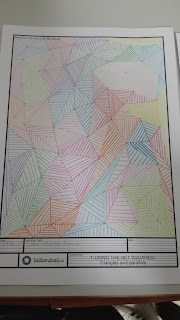
MAKE A CIRCLES

First draw two lines and where you cross you make a point and delete the lines.
From there you take the Compas and make the first circle. And you start to make circles the second you can click on any part of the circumference and the points where you cut the lines there do the circles and so all the time.
From there you take the Compas and make the first circle. And you start to make circles the second you can click on any part of the circumference and the points where you cut the lines there do the circles and so all the time.
17 November 2017
Vocabulary
UNIT 1:
Geometry: is an área, in you studies a y elementos and operations on the plane such as points, lines or shapes
Point: can be defined as the plane or location where two lines. A point don´t hace dimensions
Line: a one dimencional objet formed of infinite point.
Ray: a line wich begins at a particular point ,onli have one direction.
End point: is a point wich a line segment or a ray ends or starts
Midpoint:is a point thats a haklway between the endpoints of the line segment.
Line segment: is a line with two endpoint.
Straigth line: is a line whoes point follow the same direction.
Plane: is a two dimencional surface.
Lenght: mesurment of something from end to end.
Freehand: drawn with hand without guiding instrument.
Line/tecnical drawing: it is a drawing made with the help of supplies.
Compass: it is a tool for drawing circules and arcs and also for messuring distances between points.
Protractor: is an instrument for messuring or drawing angles on paper.
Set squares/triangles : they are two special rularse with a triangular shapes.
Eraser: is an objet to eraser things.
Marker: a pen hacina a writing point made from pressed fibres.
Ruler: is an instrument usted to draw straigth lines.
Geometry: is an área, in you studies a y elementos and operations on the plane such as points, lines or shapes
Point: can be defined as the plane or location where two lines. A point don´t hace dimensions
Line: a one dimencional objet formed of infinite point.
Ray: a line wich begins at a particular point ,onli have one direction.
End point: is a point wich a line segment or a ray ends or starts
Midpoint:is a point thats a haklway between the endpoints of the line segment.
Line segment: is a line with two endpoint.
Straigth line: is a line whoes point follow the same direction.
Plane: is a two dimencional surface.
Lenght: mesurment of something from end to end.
Freehand: drawn with hand without guiding instrument.
Line/tecnical drawing: it is a drawing made with the help of supplies.
Compass: it is a tool for drawing circules and arcs and also for messuring distances between points.
Protractor: is an instrument for messuring or drawing angles on paper.
Set squares/triangles : they are two special rularse with a triangular shapes.
Eraser: is an objet to eraser things.
Marker: a pen hacina a writing point made from pressed fibres.
Ruler: is an instrument usted to draw straigth lines.
1 November 2017
Halloween in diferent places
In Ireland :200 years ago in Ireland start the Halloween but is was not called Halloween, ti was a pagan ritual that receved the name of Samhain.
In Spain: no Dicember 31st,it was always been the eve of all the saints that has the tradicion of visiting the cementeries which the belove ones who have died are remenbered and flowers are deposited in their place of rest.
In Canada:is celebrated similar Uniated States the o ley difference is the was to disguis, the Parade is mor carnabal than terror.
In Japan: maintain the tradition of disguisin up and part of the decoration, only the y make it their own pumpkins, they are also different and they are more concerned with originality than terror motives.
In England: English Halloween has a little differences whit American or Irish, but of something is charact Erizad by competitiviness when it comes to disguise and the youngest play the famous trick or treat.


Subscribe to:
Posts (Atom)
-
 Breakfast: I haven't had breakfast. Break: I've eaten some bread sticks with pipes. Food: I have eaten rice with a fried egg. ...
 -
 -This event is important becouse Spain's national football team won the 2010 soccer World Cup, whose final phase was held in South Afric...
